

What Chronic Stress Actually Does to Your Brain — And How to Reverse It
"You are not lazy. You are not weak. You are not failing at life. Your brain is under a sustained biological attack from your own stress hormones."
If you have been feeling exhausted but unable to sleep, anxious for no reason, reactive to things that would not normally bother you, and foggy in ways you cannot quite explain — this post is for you.
Because what you are experiencing is not a character flaw. It is not a motivation problem. And it is not something a positive mindset alone will fix.
It is biology. Specifically, it is what happens to the human brain under sustained chronic stress. And once you understand the mechanism, the path forward becomes much clearer.
The stress response was never designed for this
The human stress response is one of the most sophisticated survival systems ever evolved. When you perceive a threat — real or imagined — your hypothalamus fires a signal that triggers a cascade of hormonal activity. Adrenaline floods your system within seconds. Cortisol follows within minutes.
Together they do something remarkable. They sharpen your focus, increase your heart rate, redirect blood to your muscles, suppress digestion, and temporarily suspend immune function. Everything non-essential shuts down so you can deal with the threat right in front of you.
This system kept our ancestors alive. A predator appears, the stress response fires, you run or fight, the threat passes, and cortisol drops back to baseline. The whole cycle takes minutes.
The problem is that your brain cannot tell the difference between a lion and a looming deadline. Between physical danger and a difficult conversation you have been dreading. Between a genuine emergency and the relentless accumulation of small modern stressors that never quite resolve.
When the threat never passes, the cortisol never drops. And elevated cortisol, sustained over months and years, does something that most people are never told about.
It physically changes your brain.
What chronic stress does to your brain — the science
Research in neuroscience and endocrinology over the past two decades has revealed something both alarming and, importantly, hopeful. The brain under chronic stress does not just feel different. It structurally reorganises itself in response to sustained cortisol exposure.
1. Your prefrontal cortex shrinks
The prefrontal cortex is the most evolutionarily advanced part of your brain. It is responsible for rational decision-making, emotional regulation, impulse control, and the capacity to think long-term. It is, in many ways, what makes us human.
Chronic stress reduces the volume of grey matter in the prefrontal cortex. The neurons literally shrink and disconnect. This is not metaphorical. Brain imaging studies have consistently shown measurable structural changes in people experiencing chronic stress and burnout.
This is why, when you are chronically stressed, you find yourself making decisions you later regret, snapping at people you love, struggling to see past the immediate moment, and feeling like you have lost access to a version of yourself that used to be calmer and more capable. You have not lost that person. Their neural infrastructure has been temporarily compromised.
2. Your amygdala grows and becomes hyperactive
The amygdala is your brain’s threat-detection centre — the alarm system that decides whether something is dangerous. Under chronic stress, the amygdala physically grows larger and becomes significantly more reactive.
This is why everything starts to feel threatening when you are burned out. Why small things feel enormous. Why you find yourself catastrophising about situations that would once have been manageable. Your alarm system has been recalibrated toward sensitivity — because sustained cortisol has taught your brain that the world is not safe.
This also explains the anxiety that seems to come from nowhere. Your amygdala is firing at low-level stimuli that it would not have registered before. This is not irrational. It is a predictable neurological response to sustained threat exposure.
3. Your hippocampus is compromised
The hippocampus is central to memory formation, learning, and spatial navigation. It is also one of the brain structures most vulnerable to cortisol damage. Sustained elevated cortisol reduces hippocampal volume and impairs the formation of new memories.
This is the neuroscience behind brain fog. The difficulty remembering words mid-sentence. The feeling that you read something and immediately forgot it. The inability to retain information the way you once could. These are not signs of ageing or inadequacy. They are signs of a hippocampus under cortisol stress.
4. Your sleep architecture is disrupted
Cortisol and melatonin operate on an inverse relationship. When cortisol is high, melatonin is suppressed. When melatonin should be rising in the evening to prepare you for sleep, elevated cortisol blocks it. This is why the classic dysregulated nervous system pattern is exhausted all day but wired at night.
Research published in 2025 in Clocks and Sleep confirmed that burnout is associated with altered HPA axis activity and blunted diurnal cortisol variation — meaning the normal morning peak and evening drop of cortisol becomes flattened and dysregulated. Your body no longer knows when to be alert and when to rest.
And here is the cruel compounding factor. Poor sleep raises cortisol. Elevated cortisol disrupts sleep. The cycle feeds itself, deepening with every night of inadequate rest.
What the science says about reversing it
The good news — and there is genuine good news here — is that the brain is neuroplastic. The structural changes caused by chronic stress are not permanent. With consistent, targeted support, the prefrontal cortex can recover volume. The amygdala can be recalibrated. Sleep architecture can be restored. Cortisol rhythms can return to a healthy diurnal pattern.
But it requires consistency and the right inputs. Here is what the evidence points to.
Ashwagandha — specifically standardised, patented forms
Ashwagandha is the most clinically studied adaptogen for cortisol and stress. But not all ashwagandha is equal. The research that shows meaningful reductions in cortisol — in some studies up to 24% over 60 days — uses standardised, patented extracts that provide consistent levels of the active bioactives: withanolides, withaferin A, and oligosaccharides.
Standard root-only ashwagandha powders vary enormously in bioactive content and have far less clinical evidence behind them. The form of the ingredient matters as much as the ingredient itself.
Magnesium bisglycinate
Magnesium is involved in over 300 enzymatic reactions in the body, including those that regulate the HPA axis stress response. Research consistently shows that magnesium deficiency is associated with heightened stress reactivity, poor sleep, and increased anxiety. Most adults in modern populations are deficient.
Magnesium bisglycinate is the chelated form — bound to glycine, which has its own calming properties — making it the most bioavailable and gentle form available. It supports muscle relaxation, nervous system signalling, and the neurotransmitter activity involved in sleep onset.
L-Theanine
Found naturally in green tea, L-theanine has been shown in multiple studies to increase alpha brain wave activity — the relaxed but alert state that is the nervous system’s natural resting mode and the gateway into sleep. It promotes relaxation without sedation, typically within 30 minutes of intake.
Importantly, L-theanine does not cause drowsiness, dependency, or next-day impairment. It is one of the few calming compounds that is genuinely safe for daily long-term use.
Apigenin
A bioflavonoid derived from chamomile, apigenin binds to GABA receptors in the brain to produce a calming, sleep-promoting effect without the sedation or dependency associated with pharmaceutical sleep aids. It has also shown preliminary evidence for neuroprotective properties — supporting brain health beyond its sleep-promoting effects.
Creatine for brain energy
Less well known but increasingly supported by research, creatine supports the brain’s phosphocreatine energy system — the same system it fuels in muscle tissue. Studies have linked higher creatine availability in the brain with improved cognitive performance, reduced mental fatigue, and better mood regulation. For people whose nervous system dysregulation manifests as mental depletion and low drive, creatine is a surprisingly powerful and underutilised tool.
Sleep — the non-negotiable foundation
Every other intervention is limited by the quality of your sleep. Sleep is when your brain clears cortisol, consolidates memory, repairs tissue, releases growth hormone, and runs what researchers call the glymphatic system — a literal washing of toxic proteins from neural pathways that only activates during deep sleep stages.
You cannot supplement your way around chronic sleep deprivation. But you can use targeted support to break the cortisol-sleep cycle, restore natural sleep architecture, and create the conditions under which deep sleep becomes possible again.
The three-pillar approach — why one supplement is never enough
This is the insight that informed the design of SereniTide from the beginning. The nervous system does not have one problem. It has three interconnected problems — elevated daytime cortisol, disrupted sleep, and depleted brain energy — and they reinforce each other continuously.
Addressing only one of them is like removing one wall of a structure that has three load-bearing walls. The others hold it in the same broken shape.
The most effective approach addresses all three simultaneously:
- Daytime cortisol support — to interrupt the chronic stress activation and give the prefrontal cortex the conditions it needs to begin recovering
- Night-time sleep support — to break the cortisol-melatonin cycle and restore the deep sleep stages where neurological repair happens
- Brain energy support — to replenish the cognitive resources that chronic stress has depleted, making it possible to function at capacity again
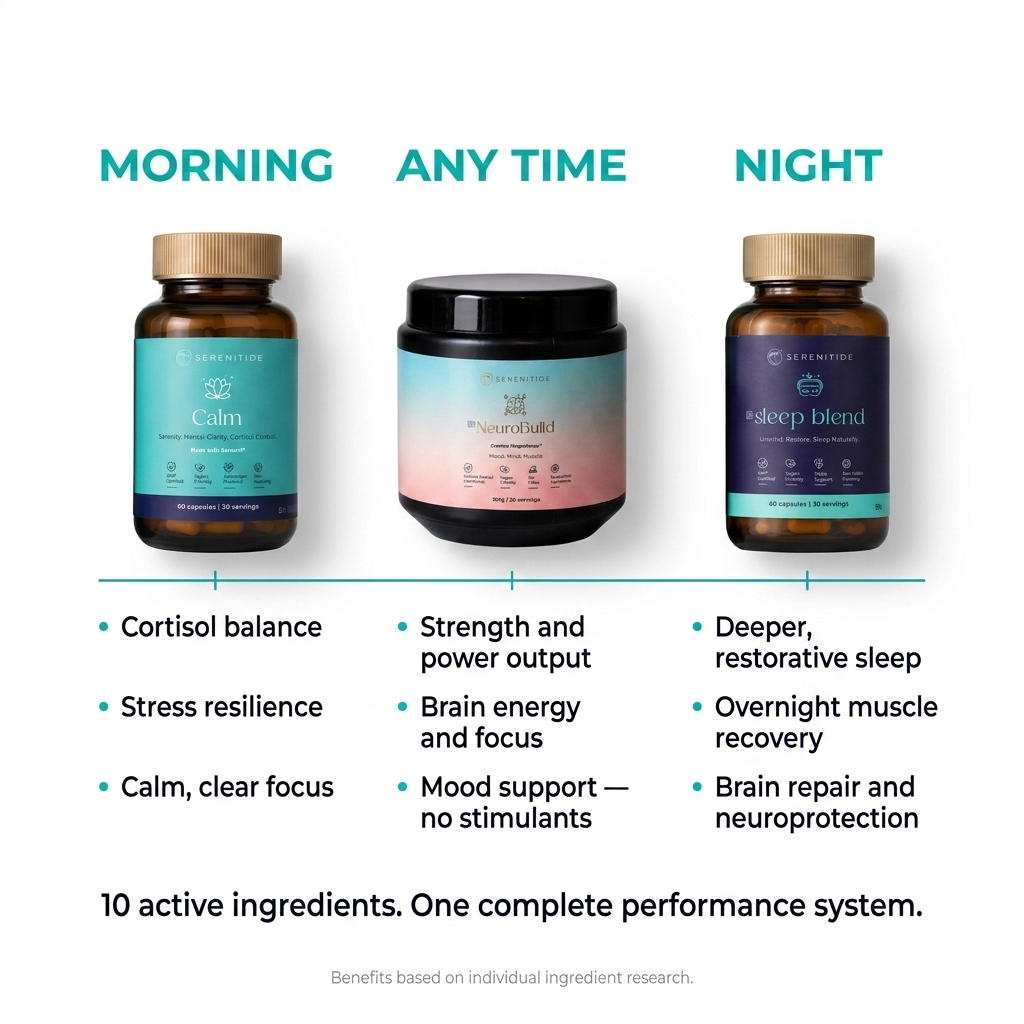
This is the architecture behind the SereniTide Nervous System Reset Bundle — SereniTide Calm for the day, the Sleep Blend for the night, and NeuroBuild for performance and brain energy. Three formulas, ten active ingredients, two patented clinically researched compounds, one daily system.
How long does it take?
This is the question everyone asks, and the honest answer is: it depends on how long your nervous system has been dysregulated.
The clinical research on ashwagandha shows meaningful cortisol reductions after 60 days of consistent use. Most people notice something within the first two to three weeks — better sleep quality is typically the first change, followed by reduced reactivity, and then gradually improved energy and mental clarity.
The nervous system did not become dysregulated overnight. It will not recover overnight. But with consistent, targeted support, the neuroplastic brain will begin to reorganise. The prefrontal cortex can recover volume. The amygdala can be recalibrated. Sleep can deepen. Cortisol can find its rhythm again.
Where to start
If any of this resonates with you, the most important thing is to start. Not perfectly. Not with all three products at once if that feels like too much. Just start supporting your nervous system deliberately and consistently.
If sleep is your primary issue, start with the SereniTide Sleep Blend. If daytime stress and reactivity are your main challenge, start with SereniTide Calm. If you need everything — if stress, sleep, and energy are all compromised — the Nervous System Reset Bundle is the most complete starting point.
All three products are available at serenitide.co.za and on Takealot, and ship across South Africa.
→ Discover more about sleep science and calm-living rituals on our SereniTide Blog.